
Build Smarter: Using the ENISA NCSS Interactive Map alongside the NCS Guide 2025
Authors:
By Ruta Jasinskiene, Cybersecurity Capacity Building Expert at NRD Cyber Security

Every country knows it needs a cybersecurity strategy. The challenge arises, when considering what it should look like, how to kick-off the process of its development and how to ensure that it can be implemented.
Over the years, our experts have worked alongside ministers, senior officials, and technical teams across multiple countries — all facing the same fundamental challenge: how do you turn a political commitment to cybersecurity into a strategy that works?
If you’ve ever been in a room full of senior officials trying to agree on a national cybersecurity strategy, you’ll recognise the pattern. The discussion goes in circles. Everyone agrees that something needs to be done — but the moment you get into specifics, consensus seems to vanish. Who leads? Which ministry owns what? Does the private sector have a formal role? How will we measure success?
These aren’t unusual questions. In fact, they’re almost universal. What changes from one country to the next is the institutional culture, the threat landscape, the digital maturity — but the underlying dilemmas are remarkably consistent. And without the right reference points, those conversations can drag on for months. Sometimes the draft strategy never makes it out of the drawer.
What “good” actually looks like
For those navigating this journey for the first time, particularly without extensive external support, the question is especially pressing: where to begin, and what does “good” really look like?
A practical starting point is to avoid reinventing the wheel. By combining the structured framework of the Guide to Developing a National Cybersecurity Strategy[1] (NCS Guide 2025) with the real-world data of the ENISA[2] National Cybersecurity Strategies (NCSS) Interactive Map, teams can move away from abstract theoretical debate about hypothetical situations and start making decisions grounded in actual experience. They can see what other countries prioritised, how institutions were structured, and how approaches evolved over time. The goal isn’t to copy existing models, but to use these resources as a lens into how others have addressed similar challenges — and to make choices that fit their own context.
A living database of real decisions
While the NCS Guide 2025 serves as the most comprehensive reference for how to build a strategy—focusing on implementation, measurement, and continuous improvement—it cannot show you what other countries have implemented. This is where the ENISA NCSS Interactive Map becomes an indispensable tool.
The ENISA NCSS Interactive Map is not a collection of policy documents. It’s something more useful: a structured, searchable view of how 31 European countries have practically organised their cybersecurity architectures — the institutions created, the laws passed, the partnerships formed, and the lessons accumulated across multiple strategy cycles.
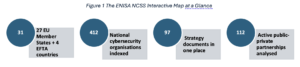
*EFTA -European Free Trade Association
More importantly, the Map’s National Implementation tab shows not just what countries said they would do — but what they actually built. These are the questions that tend to surface in every strategy room, sooner or later: How do we divide responsibilities between institutions? Where does law enforcement sit in relation to national defence? What coordination bodies do we need — and how should they function? The Map won’t answer those questions for you — but it shows how 31 countries worked through them, and that’s often all the inspiration a stuck conversation needs to move forward.
While the Map draws on European experience, the governance challenges it documents — how to structure national authorities, coordinate across ministries, and build incident response capacity — are not uniquely European. Countries at any stage of cybersecurity maturity will find the underlying patterns directly relevant to their own context.
Where it changes the conversation
In our experience, introducing the Map into a working session changes the dynamic almost immediately. Instead of theorising about governance models, teams can look at concrete examples from comparable contexts. The debate shifts from “what should we do?” to “which of these approaches makes most sense for us, and why?”
This matters at every stage of the strategy lifecycle — not just at the beginning. Here’s where the ENISA Interactive Map proves most useful alongside the NCS Guide:
During stocktaking, the NCS Guide 2025 emphasises the need to assess the national cybersecurity landscape systematically — mapping existing stakeholders, laws, and capabilities before setting objectives. The Map makes that process more structured by letting teams see which thematic areas peer countries address, which are becoming priorities in the latest strategy cycles, and which reflect context-specific choices rather than universal expectations — making it easier to identify gaps without starting from a blank page.
When it comes to governance design, the NCS Guide 2025 identifies the designation of a Competent National Authority as a foundational requirement — but the organisational model for this can vary significantly. The ENISA tool provides instant visibility into these different models, including 36 National Cybersecurity Authorities and 60 Regulatory Bodies across the region. This allows policy makers and strategy teams to compare centralised and decentralised approaches and helps them choose a model that fits their own institutional reality rather than defaulting to the most familiar one.
For incident response, the NCS Guide 2025 calls for establishing CSIRTs and ISACs to facilitate response and intelligence exchange. The Map identifies 42 CSIRTs and 98 ISACs already operating across the region — giving a country looking to build its own capabilities a concrete picture of what exists, how it’s structured, and who potential counterparts might be.
And for monitoring and iteration, the NCS Guide 2025’s strong emphasis on evaluation cycles and continuous improvement reflects a genuine maturity shift in the field — strategy as an ongoing process, not a one-time deliverable. The Map makes those cycles visible: many countries in the database are on their second or third strategy, and tracing how their priorities shifted over time is one of the most practical ways to design an evaluation framework that reflects real experience rather than theory.
Conclusion
The NCS Guide 2025 provides the structure: how to govern the process, engage stakeholders, set measurable objectives, and build in evaluation cycles. The ENISA Interactive Map provides the evidence: what others built, what choices they made, and how those choices played out over time.
Neither tool replaces strategic thinking. But together, they significantly reduce the time spent debating in the abstract — and increase the chance that a strategy makes it out of the drawer: approved, implemented, and improved over time.
In our work with governments across multiple regions, we have rarely seen a team engage seriously with this evidence base without it materially improving the quality of their decisions. The experience of 31 nations is available and navigable. That is a rare advantage — and it’s worth using.
[1] https://ncsguide.org/ncs-guide-2025/
[2] ENISA is The European Union Agency for Cybersecurity dedicated to achieving a high common level of cybersecurity across Europe. Established in 2004 and strengthened by the EU Cybersecurity Act, the European Union Agency for Cybersecurity contributes to EU cyber policy, enhances the trustworthiness of ICT products, services and processes with cybersecurity certification schemes, cooperates with Member States and EU bodies, and helps Europe prepare for the cyber challenges of tomorrow